

How Can Clean Energy Replace Coal Oil And Natural Gas
We understand today that humanity'south apply of fossil fuels is severely damaging our environment. Fossil fuels cause local pollution where they are produced and used, and their ongoing apply is causing lasting harm to the climate of our unabridged planet. Withal, meaningfully irresolute our ways has been very hard.
But suddenly, the COVID-19 pandemic brought trade, travel, and consumer spending to a near-standstill. With billions of people recently under stay-at-home orders and economic activeness plunging worldwide, the need for and cost of oil have fallen further and faster than ever before. Needless to say, oil markets accept been in turmoil and producers around the world are suffering.

The idea that the pandemic could ultimately help save the planet misses crucial points. First and foremost, damaging the world's economy is not the way to deal with climate change. And in terms of oil, what will take its place? We haven't plant a good substitute for oil, in terms of its availability and fitness for purpose. Although the supply is finite, oil is plentiful and the technology to extract information technology continues to improve, making it ever-more than economic to produce and use. The same is also largely truthful for natural gas.
Climate change is real and we see its effects clearly now: In 2022 worldwide, xv extreme weather events, exacerbated by climatic change, caused more than $1 billion in harm each. Four of these events each caused more than $10 billion in damage. The large-scale use of fossil fuels tops the list of factors contributing to climate change. But the concentrated free energy that they provide has proven difficult to supplant. Why?
A reporter raised that very question to me later on a press Q&A that I did at a briefing a few years ago. "We know that oil contributes to climate change and other environmental problems — why practice we even so apply it? Why don't we just quit already?," he asked me.
Until that moment, I hadn't thought enough virtually how my experience and background requite me a clearer view than many on the promise and challenge of moving to a cleaner energy organization. I take gained a wide-bending view of the energy industry every bit I've moved through my career, working in government and in consulting — for both oil and gas and make clean free energy clients — and and then moving into the call up tank earth.
fossil fuel
Generated from the decomposition of aboriginal constitute and animal affair over millions of years. Coal, oil, and natural gas are fossil fuels.
To bargain with the challenge of climate change, we must starting time past agreement the fossil fuel organization — namely how energy is produced and used. Although fossil fuel companies are politically powerful, in the United States and around the globe, their lobbying prowess is not the cardinal reason that their fuels dominate the global energy system. Also, the transition to an all-renewable free energy arrangement is not a simple task. Just the politics of blame are popular, every bit we've seen during the 2022 election campaign and in light of recent lawsuits against fossil fuel companies. At that place is plenty of blame to go around, from fossil fuel companies that for years denied the trouble to policymakers reluctant to enact the policies needed to strength real change. Information technology has been easier for everyone to stick with the status quo.
The world needs technology and potent policy to motility in a new direction. Throughout history, humanity'due south energy use has moved toward more concentrated, convenient, and flexible forms of energy. Understanding the advantages of today'south free energy sources and the history of past transitions can help us understand how to move toward low-carbon energy sources. With greater understanding of the climate challenge, nosotros are making huge strides in developing the technology nosotros demand to move toward a depression-carbon time to come. However, understanding how we got hither and why the modern world was congenital on fossil fuels is crucial to understanding where we go from here.
Our energy comes from the dominicus, one way or another
In the pre-industrial age, solar free energy met all of humanity's energy needs. Plants convert solar energy into biomass through the procedure of photosynthesis. People burned this biomass for oestrus and lite. Plants provided food for people and animals, which, in plow, used their muscle power to do work. Even as humans learned to smelt metals and brand glass, they fueled the process with charcoal made from woods. Autonomously from photosynthesis, humans fabricated some use of wind and h2o power, also ultimately fueled past the sun. Temperature differences in the temper brought virtually by sunlight drive the wind, and the wheel of rainfall and flowing water likewise gets its energy from sunlight. But the sun is at the heart of this organization, and people could only use the free energy that the sun provided in real time, more often than not from plants.
biomass
Establish fabric, including leaves, stalks, and woody mass. Biomass can be burned directly or processed to create biofuels, like ethanol.
This balance between human being energy utilisation and sunlight sounds like utopia, merely as the human population grew and became more urban, the bio-based energy system brought problems. In England, wood became scarce in the 1500s and 1600s, since it was not only used for fuel, simply also for edifice material. London, for example, grew from 60,000 people in 1534 to 530,000 in 1696, and the price of firewood and lumber rose faster than any other commodity. The once lush forests of England were denuded.
In 1900, roughly 50,000 horses pulled cabs and buses effectually the streets of London, not including carts to transport goods. Every bit you can imagine, this created an enormous corporeality of waste matter. As Lee Jackson writes in his volume "Dirty Former London," by the 1890s London's immense horse population generated roughly i,000 tons of dung per 24-hour interval. All this manure also attracted flies, which spread disease. The transportation arrangement was literally making people sick. The pre-fossil era was non the utopia nosotros envision.
Fossil fuels opened new doors for humanity. They formed from the transformation of ancient plants through pressure, temperature, and tens to hundreds of millions of years, essentially storing the sun'due south energy over time. The resulting fuels freed humanity from its reliance on photosynthesis and current biomass production equally its chief energy source. Instead, fossil fuels allowed the employ of more energy than today's photosynthesis could provide, since they stand for a stored course of solar energy.
Commencement coal, then oil and natural gas allowed rapid growth in industrial processes, agriculture, and transportation. The world today is unrecognizable from that of the early on 19th century, before fossil fuels came into broad utilise. Man health and welfare have improved markedly, and the global population has increased from 1 billion in 1800 to almost 8 billion today. The fossil fuel free energy arrangement is the lifeblood of the modernistic economy. Fossil fuels powered the industrial revolution, pulled millions out of poverty, and shaped the mod world.
How free energy density and convenience drove fossil fuel growth
The first big energy transition was from wood and charcoal to coal, beginning in the iron industry in the early on 1700s. By 1900, coal was the primary industrial fuel, taking over from biomass to make up half the world's fuel utilise. Coal has iii times the energy density past weight of dry forest and is widely distributed throughout the globe. Coal became the preferred fuel for ships and locomotives, assuasive them to dedicate less infinite to fuel storage.
Oil was the next major energy source to emerge. Americans date the beginning of the oil era to the first commercial U.South. oil well in Pennsylvania in 1859, but oil was used and sold in modern-24-hour interval Azerbaijan and other areas centuries before. Oil entered the marketplace as a replacement for whale oil for lighting, with gasoline produced as a by-product of kerosene production. However, oil found its truthful calling in the transportation sector. The oil era actually took off with the introduction of the Ford Model-T in 1908 and the boom in personal transportation afterwards World War Ii. Oil overtook coal to go the globe'south largest energy source in 1964.
Oil resources are non as extensively distributed worldwide as coal, merely oil has crucial advantages. Fuels produced from oil are nearly ideal for transportation. They are energy-dense, averaging twice the free energy content of coal, past weight. But more chiefly, they are liquid rather than solid, allowing the development of the internal combustion engine that drives transportation today.
Different fuels comport dissimilar amounts of energy per unit of weight. Fossil fuels are more free energy dense than other sources.
Oil changed the course of history. For instance, the British and American navies switched from coal to oil prior to World War I, allowing their ships to go further than coal-fired German ships before refueling. Oil also allowed greater speed at ocean and could exist moved to boilers by pipe instead of manpower, both articulate advantages. During World War Ii, the U.s. produced nearly two-thirds of the world'southward oil, and its steady supply was crucial to the Centrolineal victory. The German army's blitzkrieg strategy became impossible when fuel supplies could non continue upwardly, and a lack of fuel took a toll on the Japanese navy.
Natural gas, a fossil fuel that occurs in gaseous form, tin can exist found in surreptitious deposits on its own, but is oftentimes present underground with oil. Gas produced with oil was ofttimes wasted in the early days of the oil industry, and an old industry maxim was that looking for oil and finding gas instead was a quick mode to get fired. In more recent times, natural gas has become valued for its clean, fifty-fifty combustion and its usefulness every bit a feedstock for industrial processes. Nonetheless, because information technology is in a gaseous form, it requires specific infrastructure to reach customers, and natural gas is still wasted in areas where that infrastructure doesn't exist.
A final key development in earth free energy use was the emergence of electricity in the 20th century. Electricity is non an energy source like coal or oil, just a method for delivering and using energy. Electricity is very efficient, flexible, clean, and quiet at the signal of employ. Similar oil, electricity's first use was in lighting, but the development of the induction motor allowed electricity to be efficiently converted to mechanical energy, powering everything from industrial processes to household appliances and vehicles.
Over the 20th century, the free energy organization transformed from one in which fossil energy was used directly into ane in which an important portion of fossil fuels are used to generate electricity. The proportion used in electricity generation varies past fuel. Because oil — an free energy-dumbo liquid — is so fit-for-purpose in ship, little of it goes to electricity; in contrast, roughly 63% of coal produced worldwide is used to generate electricity. Methods of generating electricity that don't rely on fossil fuels, like nuclear and hydroelectric generation, are also of import parts of the system in many areas. Nevertheless, fossil fuels are notwithstanding the courage of the electricity organization, generating 64% of today's global supply.
Fossil fuels nonetheless boss global electricity generation.
In sum, the story of energy transitions through history has not merely been well-nigh moving away from electric current solar flows and toward fossil fuels. It has also been a constant move toward fuels that are more than energy-dumbo and user-friendly to utilise than the fuels they replaced. Greater energy density means that a smaller weight or volume of fuel is needed to do the chore. Liquid fuels fabricated from oil combine energy density with the ability to flow or be moved by pumps, an reward that opened upwards new technologies, especially in transportation. And electricity is a very flexible manner of consuming free energy, useful for many applications.
Back to the future – the return of the solar era
Fossil fuels allowed united states to move away from relying on today'due south solar flows, instead using full-bodied solar free energy stored over millions of years. Before we could make efficient use of solar flows, this seemed like a not bad idea.
carbon dioxide
Carbon dioxide is gas released when carbon-containing fuels (biomass or fossil fuels) are burned. Carbon dioxide is the most important gas contributing to climate alter.
However, the advantages of fossil fuels come up with a devastating downside. Nosotros now understand that the release of carbon dioxide (CO2) from burning fossil fuels is warming our planet faster than anything we have seen in the geological tape. One of the greatest challenges facing humanity today is slowing this warming earlier it changes our world beyond recognition.
Now that there are almost 8 billion of usa, nosotros clearly see the impact of ascent CO2 concentrations. Going back to the old days of relying generally on biomass for our energy needs is conspicuously not a solution. Nonetheless, we demand to discover a way to get back to reliance on real-time solar flows (and perhaps nuclear free energy) to meet our needs. There are so many more of us now, interacting via a vastly larger and more integrated global economy, and using much more free energy. Merely we also have technologies today that are much more than efficient than photosynthesis at transforming solar flows to useful energy.
Since 1900, global population and economic action have skyrocketed, forth with fossil fuel consumption.
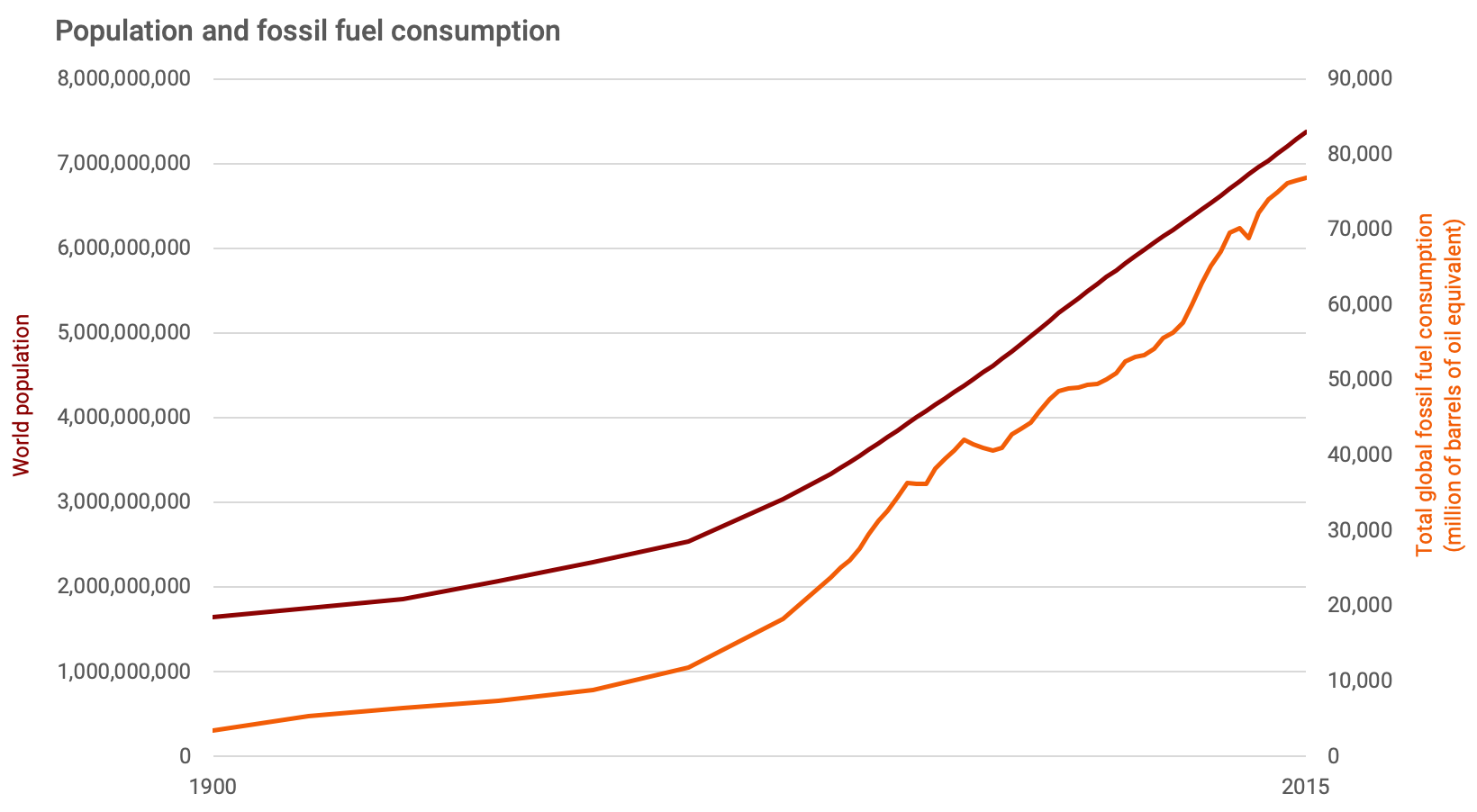
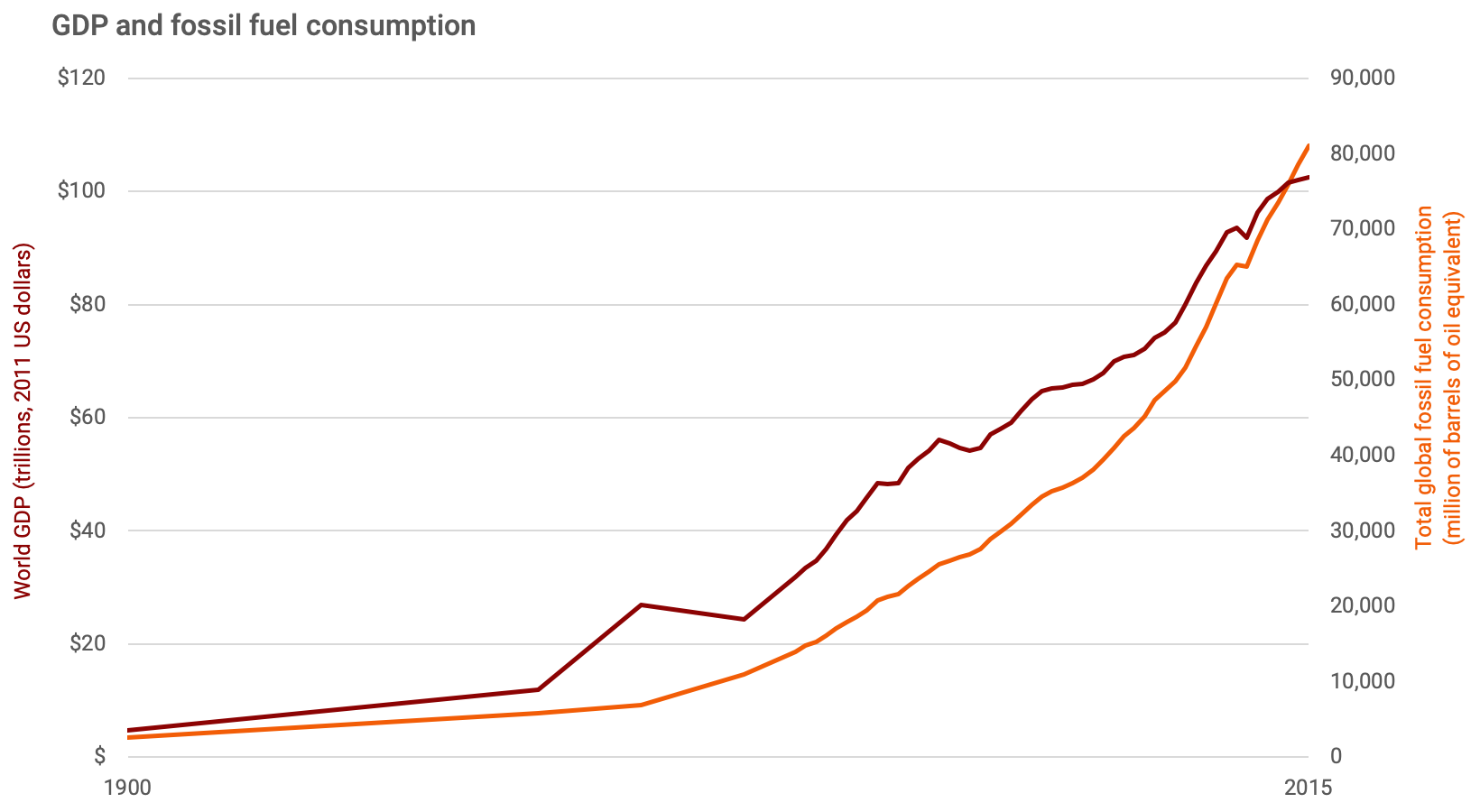
Source: Our World in Data
Unfortunately, the atmospheric concentration of carbon dioxide, the virtually consequential greenhouse gas, has steadily climbed at the same time, along with global average temperature.
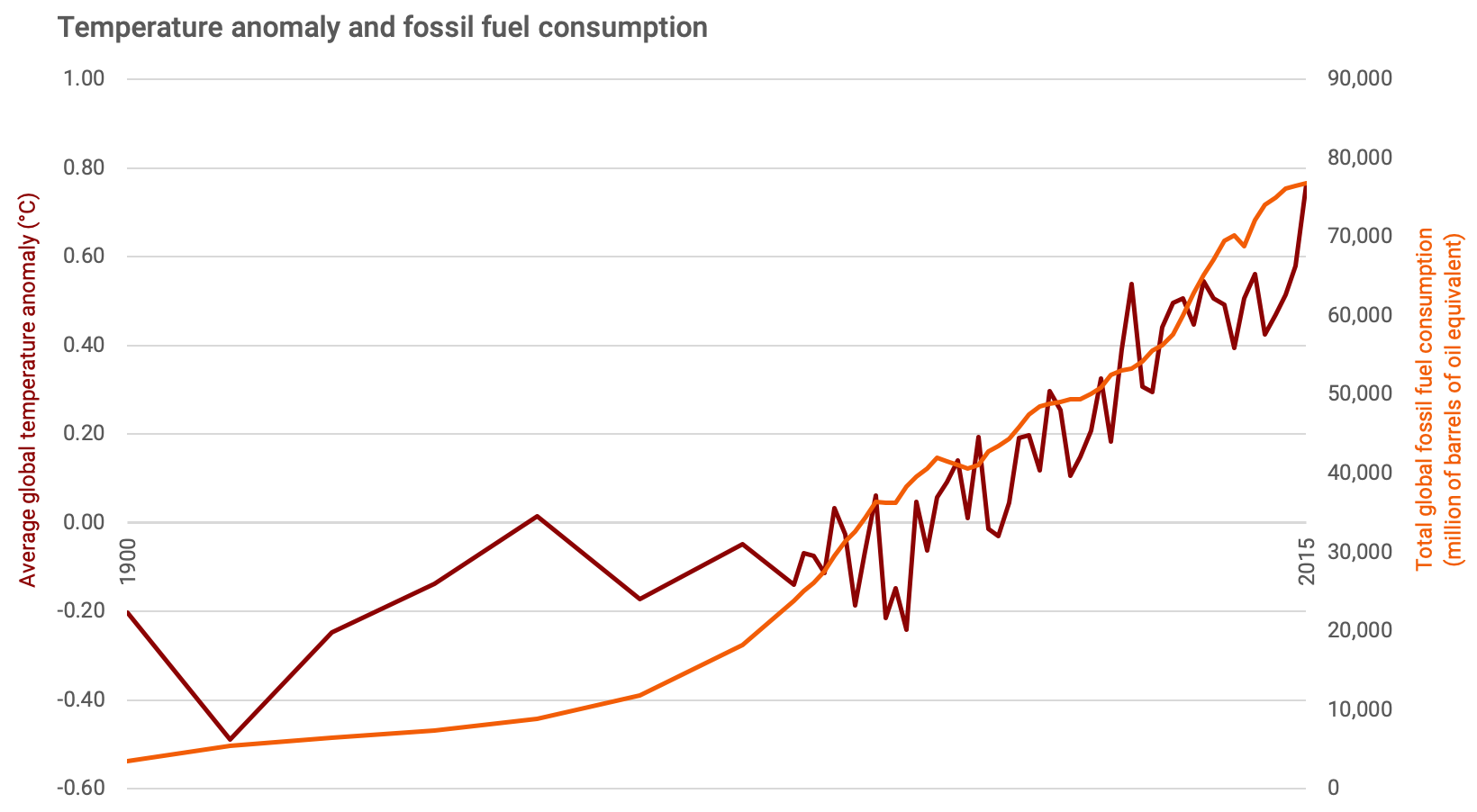
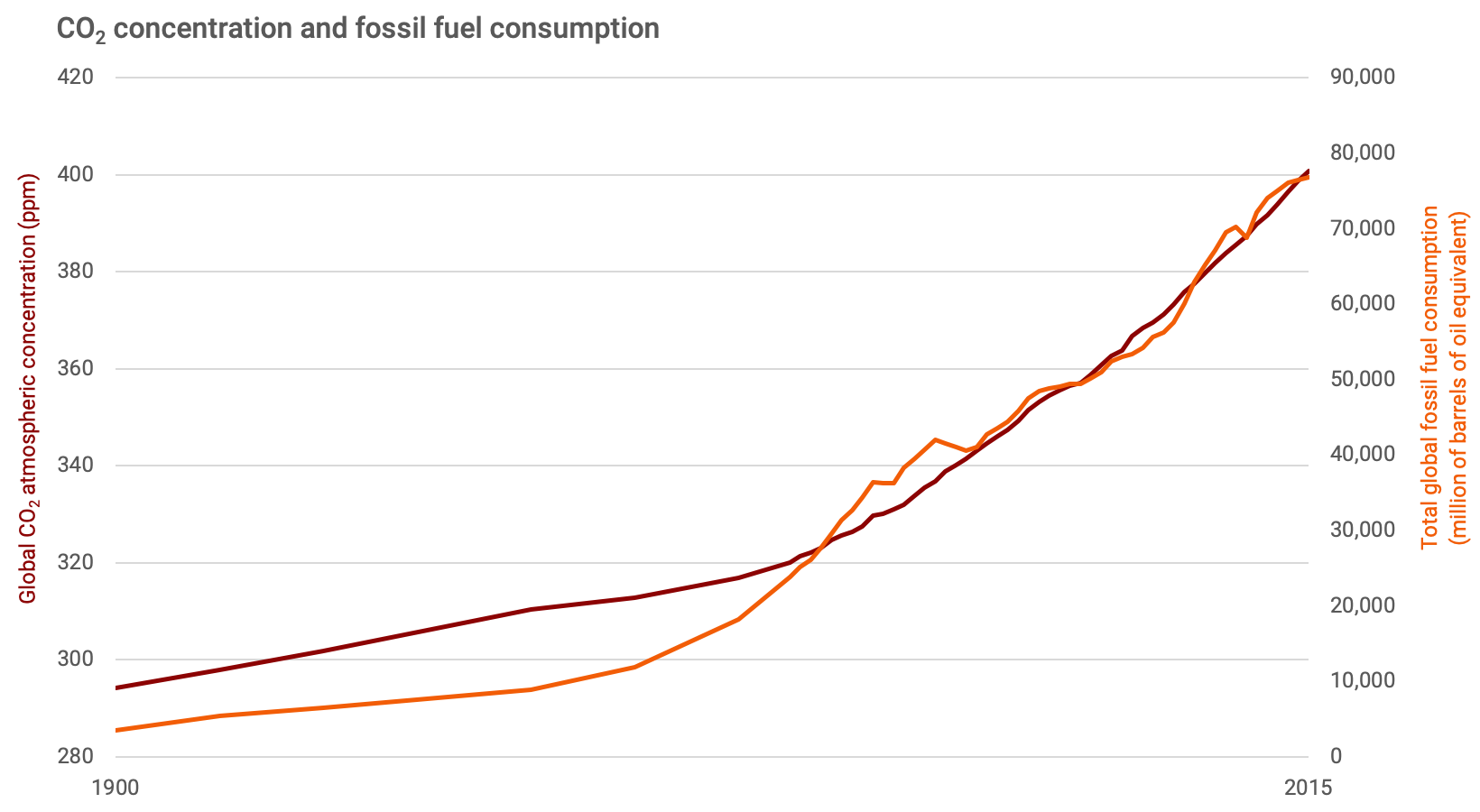
Note: Boilerplate global country-sea temperature anomaly relative to the 1961-1990 average temperature. Source: Our World in Data
The world gets plenty of energy from the sun for all of us, fifty-fifty for our modern free energy-intensive lives. The amount of solar energy that reaches habitable state is more than i,000 times the amount of fossil fuel energy extracted globally per year. The trouble is that this energy is diffuse. The sunday that warms your face is definitely providing energy, only you need to concentrate that energy to heat your domicile or move a vehicle.
renewable energy
Renewable free energy is from a source that is naturally replenished. (Ex: capturing wind using turbines or sunlight using solar cells does not modify the amount of current of air or sunlight that is available for future use.)
This is where modernistic engineering comes in. Current of air turbines and solar photovoltaic (PV) cells catechumen solar energy flows into electricity, in a process much more than efficient than burning biomass, the pre-industrial manner of capturing solar energy. Costs for wind and solar PV have been dropping rapidly and they are now mainstream, cost-effective technologies. Some existing forms of generating electricity, mainly nuclear and hydroelectricity, too don't result in COii emissions. Combining new renewables with these existing sources represents an opportunity to decarbonize — or eliminate COtwo emissions from — the electricity sector. Electricity generation is an important source of emissions, responsible for 27% of U.Due south. greenhouse gas emissions in 2022.
Still, different fossil fuels, current of air and solar tin simply generate electricity when the wind is bravado or the dominicus is shining. This is an engineering challenge, since the power grid operates in real time: Power is generated and consumed simultaneously, with generation varying to go on the system in residuum.
greenhouse gas
A gas that traps heat in the earth's atmosphere, including carbon dioxide, methyl hydride, ozone, and nitrous oxides.
Engineering challenges beget engineering solutions, and a number of solutions tin help. Ability grids that encompass a larger area are easier to rest, given that if it isn't windy or sunny in one location, it may exist somewhere else. Need-response strategies can encourage customers with flexibility in their processes to use more ability when renewable power is available and to cut back when it isn't. Power storage technologies tin save excess electricity to be used after. Hydroelectric dams tin serve this role now, and declining costs will make batteries more economic for power storage on the grid. Storage solutions work well over a timeframe of hours — storing solar power to use in the evening, for example. Simply longer-term storage poses a greater challenge. Perhaps excess electricity can exist used to create hydrogen or other fuels that tin can be stored and used at a later time. Finally, fossil fuel generation ofttimes fills in the gaps in renewable generation today, especially natural gas generation, which can exist efficiently ramped upwards and down to meet demand.
Transforming solar energy flow into electricity is a articulate place to start in creating a decarbonized free energy arrangement. A simple formula is to decarbonize the electricity sector and electrify all the free energy uses we can. Many of import processes tin be electrified — especially stationary uses, like in buildings and many industrial processes. To bargain with climate change, this formula is the low-hanging fruit.
The ii parts of this formula must proceed together. A shiny new electric vehicle in the driveway signals your concern nearly the environment to your neighbors, simply achieving its full potential do good besides requires a greener power system. For today's power system in the United States, and well-nigh everywhere in the world, electrical vehicles provide emissions benefits, simply the extent of those benefits varies profoundly by location. Achieving the full potential do good of electric vehicles would require a grid that supplies all renewable or zilch-carbon power, something that no area in the United States consistently achieves today.
Wind and solar power aren't everything – the remaining challenges
"Electrify everything" is a great plan, so far as it goes, but not everything can be easily electrified. Certain qualities of fossil fuels are difficult to replicate, such as their energy density and their power to provide very loftier heat. To decarbonize processes that rely on these qualities, you need low-carbon fuels that mimic the qualities of fossil fuels.
The energy density of fossil fuels is particularly important in the transportation sector. A vehicle needs to bear its fuel around as it travels, so the weight and volume of that fuel are key. Electric vehicles are a much-touted solution for replacing oil, but they are non perfect for all uses. Pound for pound, gasoline or diesel contain about 40 times equally much free energy as a state-of-the-art bombardment. On the other mitt, electric motors are much more efficient than internal combustion engines and electric vehicles are simpler mechanically, with many fewer moving parts. These advantages make upward for some of the bombardment'due south weight penalisation, but an electric vehicle volition still be heavier than a similar vehicle running on fossil fuel. For vehicles that carry light loads and can refuel oft, similar rider cars, this punishment isn't a large deal. But for aviation, maritime shipping, or long-booty trucking, where the vehicle must carry heavy loads for long distances without refueling, the difference in energy density between fossil fuels and batteries is a huge challenge, and electric vehicles only don't encounter the need.
WEIGHT OF FUEL
Gasoline carries much more free energy per unit of measurement of weight than a battery. A gas-powered automobile with a 12.4-gallon tank carries 77.five pounds of gasoline.

A 77.five-pound battery, in contrast, would only carry an electric car 21 miles.

An electric car with a range of 360 miles would need a 1,334 pound battery.

WEIGHT OF VEHICLE
Despite the weight of the bombardment, other components of electrical vehicles are lighter and simpler than their counterparts in a gasoline car. Thus, the overall weight penalty for electric vehicles isn't as astringent as the weight penalty for the bombardment lonely.
Industrial processes that need very high oestrus — such as the production of steel, cement, and glass — pose another claiming. Steel boom furnaces operate at virtually ane,100° C, and cement kilns operate at about 1,400° C. These very loftier temperatures are hard to achieve without burning a fuel and are thus hard to power with electricity.
Renewable electricity can't solve the emissions problem for processes that can't run on electricity. For these processes, the world needs goose egg-carbon fuels that mimic the backdrop of fossil fuels — energy-dense fuels that tin be burned. A number of options exist, but they each take pros and cons and generally need more work to exist commercially and environmentally viable.
Biofuels are a possibility, since the carbon released when the biofuel is burned is the same carbon taken up equally the plant grew. However, the processing required to turn plants into usable fuels consumes free energy, and this results in CO2 emissions, meaning that biofuels are non zero-carbon unless the entire process runs on renewable or zero-carbon energy. For example, the corn ethanol blended into gasoline in the United States averages just 39% lower CO2 emissions than the gasoline it replaces, given the emissions that occur from transporting the corn to processing facilities and converting it to fuel. Biofuels too compete for arable land with food product and conservation uses, such as for recreation or fish and wildlife, which gets more than challenging as biofuel production increases. Fuels made from crop waste or municipal waste matter can be better, in terms of country use and carbon emissions, only supply of these wastes is limited and the engineering needs comeback to be cost-effective.
Another pathway is to convert renewable electricity into a combustible fuel. Hydrogen tin be produced past using renewable electricity to split water atoms into their hydrogen and oxygen components. The hydrogen could then be burned as a zero-carbon fuel, like to the way natural gas is used today. Electricity, COtwo, and hydrogen could be besides combined to produce liquid fuels to replace diesel fuel and jet fuel. Notwithstanding, when we split water atoms or create liquid fuels from scratch, the laws of thermodynamics are not in our favor. These processes use electricity to, in event, run the combustion process backwards, and thus use large amounts of energy. Since these processes would utilize vast amounts of renewable power, they but make sense in applications where electricity cannot be used direct.
Carbon capture and storage or use is a final possibility for stationary applications similar heavy industry. Fossil fuels would notwithstanding be burned and create CO2, but it would be captured instead of released into the atmosphere. Processes under evolution envision removing CO2 from ambience air. In either case, the COii would then exist injected deep secret or used in an industrial process.
The most mutual use for captured CO2 today is in enhanced oil recovery, where pressurized CO2 is injected into an oil reservoir to squeeze out more oil. The thought of capturing CO2 and using it to produce more fossil fuel seems backwards — does that really reduce emissions overall? But studies show that the captured CO2 stays in the oil reservoir permanently when information technology is injected in this way. And if enough CO2 is injected during oil product, information technology might make up for the combustion emissions of the produced oil, or even result in overall negative emissions. This won't be a panacea for all oil employ, but could make oil use feasible in those applications, like aviation, where it is very difficult to supercede.
Carbon capture is today the cheapest way to bargain with emissions from heavy industries that require combustion. Information technology has the reward that it can also capture CO2 emissions that come from the procedure itself, rather than from fuel combustion, as occurs in cement production when limestone is heated to produce a component of cement with COtwo as a by-product.
When considering how carbon capture might contribute to climate change mitigation, nosotros have to think that fossil fuels are not the ultimate cause of the problem — CO2 emissions are. If maintaining some fossil fuel use with carbon capture is the easiest way to deal with sure sources of emissions, that's still solving the primal problem.
Our biggest challenges are political
Science clearly tells usa that we need to remake our energy system and eliminate CO2 emissions. However, in addition to the engineering challenges, the nature of climate alter makes it politically challenging to deal with as well. Minimizing the impact of climatic change requires re-making a multi-trillion-dollar industry that lies at the center of the economy and people's lives. Reducing humanity's reliance on fossil fuels requires investments here and at present that provide uncertain, long-term benefits. These decisions are particularly difficult for politicians, who tend to focus on policies with immediate, local benefits that voters can see. Last year The New York Times asked, for instance, "whether any climate policy is both big enough to matter and popular enough to happen." Durable climate policy requires securing purchase-in from a range of actors, including politicians from both parties, business leaders, and ceremonious social club. Their perspectives inevitably differ, and the lack of consensus — combined with very real efforts to exert pressure on the policymaking process — is a key reason that climate activity is so politically difficult. (To try your hand at navigating the policy dilemmas, play our — absolutely simplified! — game below: "A president's climate quandary.")
In the United states and other parts of the wealthy world, current efforts focus on reducing the greenhouse gas emissions from our energy-intensive lives. Just the second part of today's energy claiming is providing modern free energy to the billion people in the developing world that don't currently have it. You don't hear as much nigh the second goal in the public discourse about climate change, but it'southward crucial that developing countries follow a cleaner path than the developed globe did. The need to provide both cleaner free energy and more energy for developing countries magnifies the claiming, but a solution that leaves out the developing earth is no solution at all.
Plentiful and inexpensive fossil fuels brand transitioning away from them more hard. Around 15 years ago, pundits were focused on "tiptop oil" — the idea that the globe was running out of oil, or at to the lowest degree cheap oil, and that a reckoning was coming. Events of the past decade take proven that theory wrong. Instead of declining oil production and rising prices, we've seen the opposite, nowhere more than than here in the United States. Technology has brought about a boom in oil production; geologists long knew the resource were there, just did not know how to make coin producing them. There's no reason to expect this trend to dull downwardly anytime soon. In other words, running out of oil will not relieve u.s.a.. The world will need to transition away from oil and other fossil fuels while they are abundant and cheap — not an easy job.
To achieve this technically and politically challenging transition, nosotros need to avert one-dimensional solutions. My own thoughts nearly how we need to deal with climate change have certainly evolved over time, every bit we sympathize the climate system ameliorate and as time passes with emissions still increasing. Equally an case, I used to be skeptical of the idea of carbon capture, either from industrial processes or straight from the air. The engineer in me just couldn't see using such an energy-hungry procedure to capture emissions. I've changed my listen, with a greater understanding of processes that volition be hard to decarbonize whatever other mode.
The accumulation of COtwo in the temper is like putting air into a balloon. It's a cumulative system: We're continually adding to the full concentration of a substance that may last in the atmosphere for up to 200 years. We don't know when the effects of warming will become overwhelming, but nosotros do know that the system volition become stretched and compromised — experiencing more negative furnishings — as the airship fills. The cumulative nature of the climate arrangement means that we need more stringent measures the longer that we look. In other words: Sooner action is better. We need to accept action now where it's easiest, in the electricity and light vehicle sectors, and in making new buildings extremely energy efficient. Other sectors need more technology, like heavy transport and manufacture, or volition take a long time, like improving our existing stock of buildings.
Those pushing to terminate fossil fuel production now are missing the point that fossil fuels will still be needed for some time in certain sectors. Eliminating unpopular energy sources or technologies, similar nuclear or carbon capture, from the conversation is brusk-sighted. Renewable electricity generation lone won't get us there — this is an all-technologies-on-deck problem. I fear that magical thinking and purity tests are taking hold in parts of the left stop of the American political spectrum, while parts of the political right are guilty of outright denialism around the climate problem. In the face of such stark polarization, the focus on practical solutions can get lost — and practicality and ingenuity are the renewable resources humanity needs to meet the climate challenge.
Correction: An earlier version of a graphic in this piece mistakenly indicated that renewables comprise 0.vi% of global electricity generation. Information technology has been corrected to 9.3%.
About the Author

Acknowledgments
u003cpu003eu003cstrongu003eEditorial:u003c/strongu003e Jeff Ball, Bruce Jones, Anna Newbyu003c/pu003eu003cpu003eu003cstrongu003eResearchu003c/strongu003e: Historical summaries of free energy transitions owe a debt of gratitude to Vaclav Smil, a prolific writer on the topic and the grandfather of large-picture thinking on energy transitions.u003c/pu003e
u003cpu003eu003cstrongu003eGraphics and designu003c/strongu003e: Ian McAllister, Rachel Slatteryu003c/pu003eu003cpu003eu003cstrongu003eWeb developmentu003c/strongu003e: Eric Abalahin, Abigail Kaunda, Rachel Slatteryu003c/pu003eu003cpu003eu003cstrongu003eFeature imageu003c/strongu003e: Egorov Artem/Shutterstocku003c/pu003e

Source: https://www.brookings.edu/essay/why-are-fossil-fuels-so-hard-to-quit/
Posted by: johnsonutred1960.blogspot.com
0 Response to "How Can Clean Energy Replace Coal Oil And Natural Gas"
Post a Comment